Could you tell us a few things about how the group was formed? What practices, experiences and goals made it possible for the comrades who today make up the Movements for Class Autonomy to come together? And why do you emphasize the concept of “class autonomy”?
The collective Movements for Class Autonomy (KTA) was created 5 years ago following a call for discussion, addressed by comrades who had participated in the 2006-2013 cycle of struggle. These comrades were involved in a process of critical evaluation of the struggles. The people who responded to the call were the first ones that participated in the group. They came from various social and political backgrounds (neighborhood assemblies, worker collectives, anti-fascist groups, self-managed spaces, etc.), however the experience they had most in common was the student occupation movement of 2011.
The first steps of the collective was the attempt to form a common opinion on three issues that had already been raised in the call: the first one concerned the general mapping of the political framework within which the process would function. The second was an evaluation of the state of the movement and social antagonism at the time. Finally, the third one had to do with determining the characteristics of the process that we wanted to establish.
We could say that the KTA was formed mainly around what we don’t want to be. We don’t want a strictly theoretical process that will be satisfied with carrying out political analyses detached from the movement, nor a process that will glorify sterile activism, i.e. “getting things done,” which would superficially touch on current events and reproduce the logic of “robin hood”, reinforcing the passivity of the exploited and the tendency to “assign” the process of struggle to any kind of experts. We do not want to be another collective that will only publish its opinions framed by ideologies, citing social issues from the position of a specialized political body detached from everyday life. We do not want to be hetero-defined by struggles around individual issues that constantly reoccur detached from historical context, through the strategies that the state and capital employ against us (e.g. cycles of repression – reaction from a militaristic perspective). We do not want to define ourselves through the concept of solidarity as an isolated and abstract methodology that in recent years has also become synonymous with philanthropy. We do not want to mediate social struggles by shaping them in ways that fit into our own institutional compromises, thus preserving our existence, just as left-wing parties and bureaucratic unions have traditionally done.
ΚΤΑ want to be an interface between the struggles that arise here and there from small or large collective refusals against capitalist exploitation. We want to influence and to be influenced by the subjective experiences of struggles that arise across the spectrum of the exploited class, contributing and participating in them with respect to their autonomy. This is a plan that begins first and foremost with its members, through the communication of everyday life experiences and the problems that each and every one of us face in our workplaces and more generally the spaces of social reproduction. We want a process capable of interpreting the experiences of the previous cycle of struggle in order to acquire the appropriate analytical tools to interpret today’s reality. We want a process capable of evaluating the methodologies of social movements of the past and inventing new ones while being in a dialectical relationship with the constantly changing social antagonism.
Our name “Movements for Class Autonomy” indicates the way in which we engage in struggles. Movements as part of a broader movement, but also as the way we choose to engage in issues such as campaigns or with small -competitive to capital- movements towards class autonomy. We do not perceive the class to be a static category with socio-political characteristics, shaped only by the position in the field of production, but as a dynamic relationship of struggle, which is constituted on the basis of competition.
What are your fundamental theoretical references and what historical experiences of our class do you refer to or claim as a legacy?
As we mentioned earlier, as a collective we have some basic political agreements, however, we have not come together on the basis of a political identity, that is, we have not invested time to first acquire a common ideological framework and then to act. All the same, we build our theory by participating in the social struggles of our time period. This is because we believe that revolutionary theory cannot be formed separately from the experience of the exploited and oppressed. Therefore, by participating in social competition and the problems that it brings to light, we shape our theory. We are not empiricists, but we also do not aspire to do – and not to do – theory in the traditional sense of the term. Obviously, we belong to the political space of autonomy/anti-authoritarianism with the meanings that it carries against the state, capital, and the intermediaries of every type of authority: political, religious, local, media, economic, which hold this society together.
In which specific struggles have you participated in and intervened directly in the last year?
Initially, we think it is important to note that since the Covid-19 pandemic until today, there has been a flourishing of militant struggles that seem capable of reviving unionism in the workplace. Class conflicts appear more frequently in sectors of strategic importance for the economy and in new models of capitalist development (etc, logistics, gig economy). This is because capital investments are shifting there and the protagonists of these struggles (a large proportion of them are proletarians who come from the tough experience of migration) strongly resist their violent devaluation.
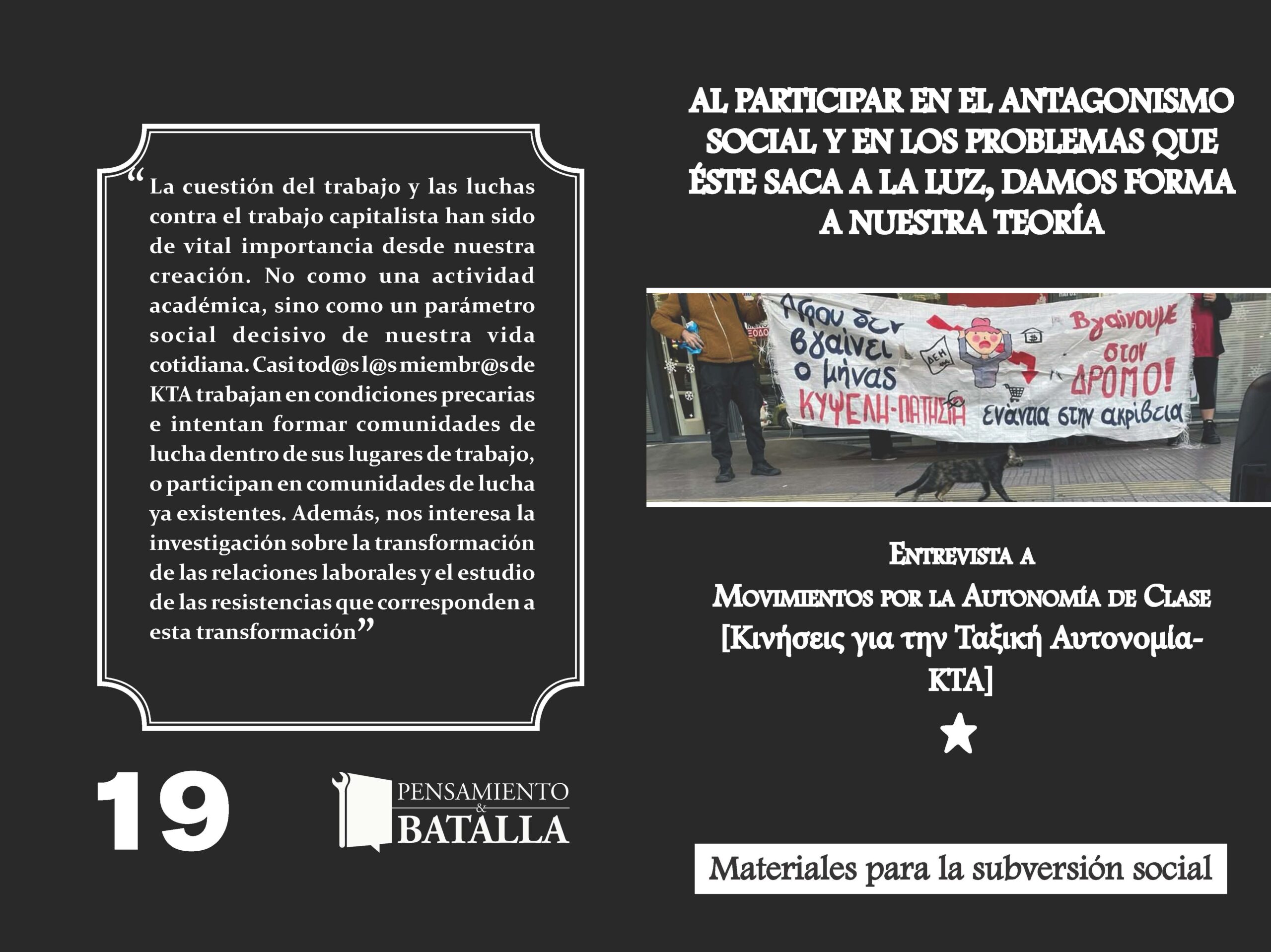
The issue of work and the struggles against capitalist labour has been of central importance since our establishment. Not as an academic pursuit, but as a decisive social parameter of our everyday lives. Almost all of the members of the KTA work in precarious working conditions and try to form communities of struggle within their workplaces, or participate in already existing communities of struggle. In addition, we are interested in research on the transformation of employment relationships and the investigation of the resistances that correspond to this transformation. For example, during the pandemic we were quite preoccupied with the form of telework and the possible resistances that can develop against it.
For the past one and a half year, we have actively participated in the months-long struggle of the employees of the company Teleperformance Greece, uniting our voices with them under the slogan “Enough is Enough”. KTA perceived this particular struggle to be a very important one and we tried to strengthen it with every means necessary. This is because the militancy demonstrated by this multinational community of strikers, but also because it is essentially a mobilization against the new labor relations (teleworking). Thus, 1.5 years ago, after an invitation addressed to us by a group of comrades/workers in call centers, some of whom were in mobilization processes at Teleperformance, we jointly formed the initiative “Workers in Call Centers & IT”. Our aim was to strengthen the already existing resistances developing in these fields and first of all, the already existing movement within this particular company.
Regarding the company, Teleperformance Greece is a subsidiary of the French multinational Teleperformance, which undertakes customer service services for products of technology giants such as Apple, Meta, etc. Now it employs more than 13,000 employees and has 13 branches in 4 cities in Greece. The company’s upward trajectory and gigantic profits are due exclusively to the over-exploitation of thousands of proletarians who work daily under intensive conditions. Such work takes place within successive customer service calls that do not stop until a 30-minute break they are entitled to daily – with rolling hours and work on weekends and holidays – with the daily stress of evaluation of their performance, which will theoretically determine the renewal of their contract. The company employs the strategy of mainly signing short-term contracts (i.e. 3-month, 6-month or annual individual contracts), through intermediary employment agencies, thus evading its legal obligation to permanently hire long-term employees. It is therefore a multinational company that employs a large number of employees with short-term contracts in a teleworking regime. In addition to Greek, one of the main nationalities of the employees is Tunisian.
These workers took matters into their own hands and organized -through mass direct democratic assemblies that were held in two languages -processes of militant mobilization in the form of work stops, strikes (7 in one year), demonstrations, etc., with the aim, on the one hand, of signing a collective labor agreement and, on the other hand, of breaking the labor conditions, especially those concerning foreign workers outside the EU, where as soon as their contract ended, they also lost the right to stay in the country. And they achieved a lot. The decoupling of the special purpose visa from their employment contract at Teleperformance, the disruption of the contracting regime used by Teleperformance, the establishment of a primary union in the company are just some of them.
In December 2024, and as the demands of the employees in the company were ongoing, the management decided to proceed with layoffs (non-renewal of contracts) and intimidation of the leading employees and members of the company’s union. The moment when our intervention became most active is when the initiative “Call Center & IT Workers” together with laid-off employees and other collectives, proceeded to create the solidarity campaign “We all know”. The solidarity campaign aimed to make the struggle more widely known in the competitive movement and in the world of work. The main goal of our action was to highlight the vengeful dismissals. We achieved this with posters, leaflets and interventions to the company’s customers. The revelation that Teleperfomace was laying off strikers clearly disturbed the company, which sent extrajudicial notices to former employees and members of the union’s board of directors. We knew from the beginning that the solidarity campaign could not replace activisation within the company. Its role was to function as a complement – and in many cases, to undertake actions that the union could not proceed with. The campaign highlighted how important the action of such initiatives is and how vulnerable companies that rely on advertishments and a “good corporate profile” are. At the same time, however, as most of the laid-off workers found work in other call centers, the possibility of meaningful intervention within Teleperformance was lost. Teleworking also contributed to the objective difficulty of maintaining contact with Teleperformace employees. We recognize this as a deficit and as a limit in our action, so that solidarity can continue to be expressed within the company. Today, the struggle is at a critical point. The case of retaliatory dismissals will be decided in court and this means that it will take time. The union today does not resemble the union it was a year ago: a vibrant community of struggle with frequent assemblies and actions, while a significant part of the members who pioneered the strikes and formed an autonomous, militant tendency within it, no longer work at Teleperformance.
We understand that you have been particularly active in struggles for cost-of-living “self-reduction” at supermarkets. Could you explain this initiative in further detail?
In the current period of economic crisis, apart from workplaces, social reproduction can become vital field for the development of a new wave of social struggles as an answer to the dramatic increase of cost of living -expressed through inflation- and to the consequences it has on our lives. In KTA, we thoroughly discussed the subject of inflation, pointing out both its potential and the crucial role it played in the post-pandemic capitalist world. At the same time, we highlighted the opportunity that bosses found to load the weight of the economic crisis on our shoulders, using as the energy and supply chain crises as a pretext. The price increases in basic goods and services were far greater than the ones justified by the transient (or not) effects of these factors.
The major question was how could we address this issue in our daily lives in a way that, from the one side could deconstruct the government narrative of “imported cost-of-living hikes” (i.e. due to the Ukraine/Palestine conflicts), by pointing out the core culprits, and from the other side would help us discover and reinforce behaviours of resistance and denial of price increases within our class. During that time, mainly referring to 2022, we took part in a coordination of political procedures and assemblies that recommended mass interventions, which peaked in a modest rally, under banners that read: “Only through struggles will prices drop and salaries rise”.
In the broader resistance movement, although this issue was brewing, since it hits the biologic root of the working class, the only movements that were selected were accusative declarations and general criticism to the government sporadically and within the confines of a specific trade field. This has been, and remains, the general political practice, from the constitutional left to the anarchist field, if we exclude some isolated, activist attempts of supermarket goods’ expropriation and distribution of these goods in the surrounding areas. On the contrary, we were preoccupied in fidning a systematic approach to highlight the issue, that would involve parts of the working class.
In this context, we were familiar with struggles that political groups in the eastern suburbs of Athens were fighting, through interventions in regional supermarkets, trying to achieve price drops for their members. We decided to focus or efforts on actions against price hikes in this field, given:
a) A significant part of the cost-of-living crisis consequences could be attributed to high supermarket goods prices
b) Supermarket bosses made a fortune during the COVID-19 lockdowns and their profits kept increases since they were aggressively using inflation tactics, stepping on our everyday needs and squeezing their workers dry
c) The foodstuff sector is vital to literally the whole working class
d) There was already some experience, as explained, within the movement
We addressed again political groups and assemblies that had already been involved in this issue and we proposed self-cost reduction interventions in supermarkets – blocking the tills and demanding price cuts at the total bill of everyone that was shopping inside, for the whole duration of the intervention (1-2 hours on average).
The first of these intervention occurred on 02/2023, in Kypseli, a central Athens neighborhood with a significant proportion of immigrants. It was exceptionally interesting and a teaching experience for us. Shoppers at the time were unexpectedly supportive and willing to participate. People we never met before where cheering, clapping and actively participating in negotiations with the supermarket manager, demanding to cut their basket bills by 15%.
We had several discussions regarding these interventions. It could be said that we caught the pulse of social dissatisfaction, deepening it and systematising it, through the coordination of “Political groups against the cost-of-living crisis”. Sterile political activism was not in our agenda. We sought to build social roots and build a new example of advocacy within our class. By choosing neighborhoods where many members of our group live, we tried to build a community of people. It seemed like a worthy cause with a well-defined goal.
With this mindset, after a pubic exhibition of “Political groups against the cost-of-living crisis” in 12/2023, we created, along with other groups and individuals who are permanent residents of the region, the neighborhood assembly “Kypseli-Patisia against price hikes”. Since then, the story of our intervention in this field, is more or less the story of the activity of this neighborhood assembly – With what it has achieved, and has not achieved so far.
What are the goals of the “New Worker Times” newspaper that you publish? How was this militant journalism received by workers participating in struggles?
The “New Worker Times” initiative is a disorderly, periodic publication produced by our group, KTA. The magazine is distributed hand-by-hand, free of charge, mainly during rallies and strikes, but also via squats and self-organised social centres. This publication has two core goals: Firstly, to highlight worker struggles being conducted around us -whether these have become well-known or not- whether they are “big” or “small”. We don’t just want to focus on journalistic coverage, filling columns with rally and strike correspondence, but to understand the content of these class clashes and to investigate the ways that these clashes can transform social relations and beliefs. Secondly, the newspaper attempts to communicate struggle experiences: To collect, share and distribute the knowledge produced through worker resistance, in order to encourage and motivate others in our class. Therefore, the essence of our initiative is a workers’ inqury from below, in contrast to following ready-made political programmes.
Up until now, we have published 2 issues of 500 copies each and we are currently working on releasing a third one, which is expected in October. Given the early stage of this initiative, its appeal remains limited. However, there have already been some memorable moments worth sharing. In the second issue there was extensive mention of the struggle of teleperformance (TP) workers. This brought us in contact with TP strikers, with whom we were able to develop political relations. Another key moment was an interview with a courier, who criticised their bureaucratic trade union. This criticism provoked the union’s reaction, therefore opening dialogue about the nature and role of syndicalist leadership. In the first two issues, apart from highlighting important struggles and strikes, we hosted three interviews with comrades, tourism seasonal workers on Greek islands, a core sector of the national economy based on GDP metrics. Lastly, within the newspaper, we submit our collective position on unions and syndicalism.
Which other collectives do you coordinate with? What are your criteria for developing more stable alliances and areas of convergence within the competitive movement?
Another moment when KTA chose to coordinate its actions with other collectives was in the spring of 2021, during the second wave of the covid pandemic, which spread pain and death, swiping away all the narratives of successful management circulated by the greek state. We called on collectives, health workers and activists to jointly plan and implement an intervention campaign against healthcare exclusions (the campaign’s name was “health without exclusions”). It is worth mentioning a few more things about this initiative as it was one of the most important moments in our struggles against the state’s management of the pandemic. We started a discussion with collectives in which we shared common perceptions, aiming to undertake joint political action through interventions in the public health sector, to communicate with its workers and its patients. We focused on three issues: “a) highlighting the criminal management of the pandemic, b) broadening the concept of health as a social relation i.e. its role in our social reproduction and the relationship between users-patients and healthcare professionals, c) bringing these two subjects together to exchange experiences and concerns in the context of common struggle.”
Indeed, working intensively for quite some time with individual comrades and comrades that are members of the 10 collectives that participated in the campaign, we managed to meet with primary health unions and collectives that are fighting within the health sector and stand in solidarity with their struggles. We tried to feature the various exclusions from the public healthcare system due to poverty, national identity, gender, sexual orientation, etc., and to actively challenge the state’s management of the pandemic. Among our many interventions, we consider the protest march that advocated the strengthening of primary healthcare structures, organised together with the “Assembly of users and workers of Kerameikos Local Health Unit”, as the most important one, as we had the chance to meet with this militant group and support their struggles in the neighbourhood. In response to the second part of the question, over the years, KTA has focused its efforts on struggles that, in our collective assessment, are crucial to the interests and needs of the exploited and oppressed. Each time we try to inspect the situation, formulate clear political views, and collaborate with collectives that have been formed based on the principles of self-organization and equal participation – collectives that aim to create or reconstruct communities of struggle. This is so far, the logic that shapes our practical interventions and view on tactics and strategy within the movement.
We have also noticed that you have been actively involved in the fight against patriarchy. How was that experience for you? How would you describe the feminist movement associated with the radical left in greece?
Unfortunately, our collective has not managed to take the necessary initiatives, nor has it actively participated in recent struggles against gender-based and domestic violence and sexual exploitation, therefore we cannot answer this question adequately. We will however say a few words, to present a view of the situation. There are ongoing struggles against trafficking networks whose activity has come to light, revealing a direct linkage between the mafia, the police, politicians and powerful business interests. Since the period of lockdowns (2020-22), voices against patriarchal violence and femicides have been growing louder and many feminist collectives emerged, acting against incidents of sexism, harassment and abuse, even within the left and anarchist movement. Today, there are consistent feminist and LGBTQI+ groups, collectives and neighbourhood assemblies with valuable experience, which have organized numerous actions against patriarchy, homophobia and transphobia, and have stood by survivors, offering them material, phycological and financial support.
What are your prospects for the immediate and medium-term future as a collective?
This year we celebrated five years of existence and action and organized a five-day festival with events and discussions. The festival was a good opportunity to review our journey so far – whether we achieved our goals or not, our level of development and our impact on the movement and the people with whom we struggle together.
Regarding future projects; it is certain that we won’t lack opportunities for intervention: Inflation persists unrelenting in basic commodities such as food, fuel and energy. There is a consistent devaluation of direct and indirect wages that limits the reproductive capacity of the working class. Public healthcare and education are continuously being attacked by the state and remain a permanent area of struggle (student protests, university occupations, strikes etc). We want to address all these issues, considering of course our limited power.
Furthermore, the greek state is actively participating in the war in ukraine, by sending military equipment and transforming the whole country into a NATO military base. It is also complicit in the genocide of the Palestinians, not only by providing political and ideological support for the israeli state, but also through channelling university research to the israeli war industry, performing mutual army exercises and ongoing economic cooperation.
We are also deeply concerned about the EU’s plan “Re-Arm Europe” (proposed by commissioner von der Leyen) to raise billions of euros for funding the military industries of the european countries, as it indicates a political turn towards war economy. Clearly most of this money will be extracted from taxation and money that would otherwise be directed to social spendings. This is a direct attack to the workers, pensioners and poor people, as wages, pensions and social benefits will be downsized even more.
NATO’s chief Mark Rutte said it clearly a few months ago in his speech to the European Parliament: “On average, governments spend a quarter of their national income on pensions, health and social security systems. We only need a percentage of that money to strengthen our defence.”
Whether there will be an escalation to generalised war or not, our daily lives are becoming more challenging due to the regional conflicts that are already raging across the world. The greek state’s adjustment to the EU’s war planning, its initiatives (dispatching of warships to the Gulf of Aden through the European military operation “Shields”) and its overall foreign policy, are pushing greece deeper into the war fronts and lay the ideological groundwork for strengthening national unity and obedience to “external threats”. Alongside the aggressive foreign policy comes the normalization of poverty, exploitation, and repression inside the country. We have much work to do as a movement. From blocking the logistics of military equipment transportations to stopping the military fundings of universities, we need to find ways to resist against the transformation of the economy into a war economy and the emerging militarism. At the same time, we believe that the development of an internationalist political stance, by creating active communities of struggle between local and immigrant workers that promote common class interests, is of great importance. The issue of war is class-based and poses a huge challenge for every collective and each activist who defends the cause of social liberation.
Check out also the Facebook pages:
Political Campaign “Health without Exclusion”
https://www.facebook.com/ygeiaxorisapokleismous
Assembly of users and workers of Kerameikos Local Health Unit https://www.facebook.com/profile.php?id=100063464411128
Kypseli-Patisia against price hikes
https://www.facebook.com/profile.php?id=61555657040675
Solidarity campaign in support of the struggle of Teleperformance workers “We all know “
https://www.facebook.com/profile.php?id=61573042557305