

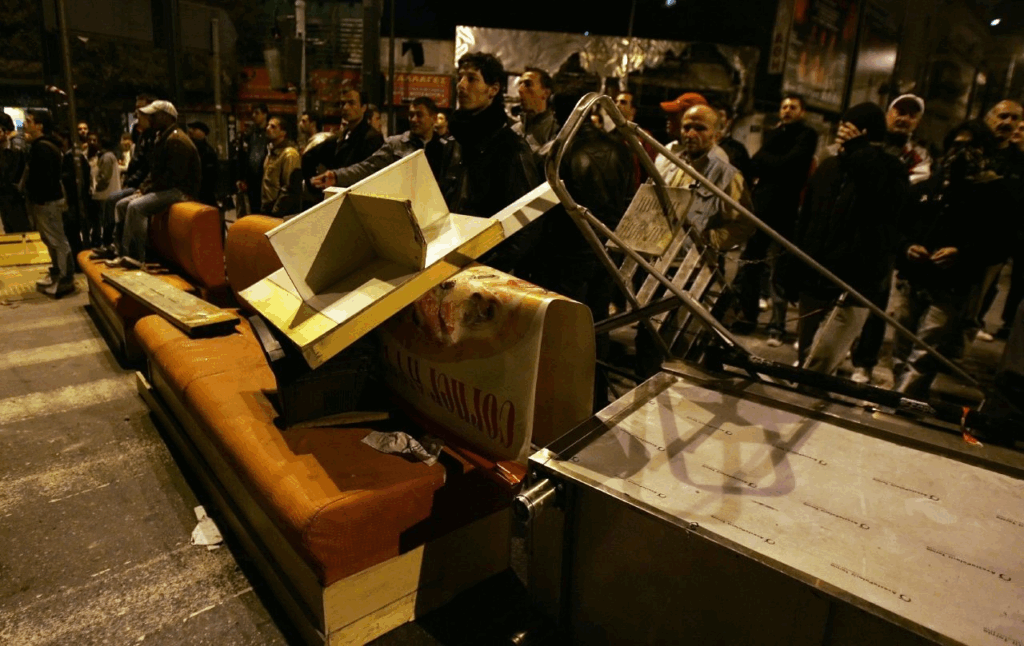
If you were a December night, who would you haunt?
17 years after the 2008 December uprising, one wonders what remains from those 20 days and nights when everything seemed possible.
The vast majority of people who participated in the uprising have sunk into survival mode. Most of the initiatives and communities of struggle that flourished during those days have practically withered or dissolved. The spaces that had been liberated from the state and commerce dominions have returned to the state and commodified.
This situation is not historically unprecedented: this is how usually things happen, as time sweeps away not just the material expression of historical phenomena, but even more so people themselves, social relations, and even memories. Therefore, the question that might still have meaning today is not what remains of the December uprising, but what deserves to remain for the generations that will want to draw inspiration and strength from it. Beyond recording the physical, emotional and intellectual memory inscribed in the bodies and minds of those who participated in the uprising, it’s even more important to think politically about the things worth not just saving from enforced oblivion, but also worth receiving further collective processing within the framework of the antagonistic movement’s processes. Knowing that neither the first nor the second has happened to the extent required by historical needs, we’ll limit ourselves to tracing some of these political elements we believe are worth (re)thinking.
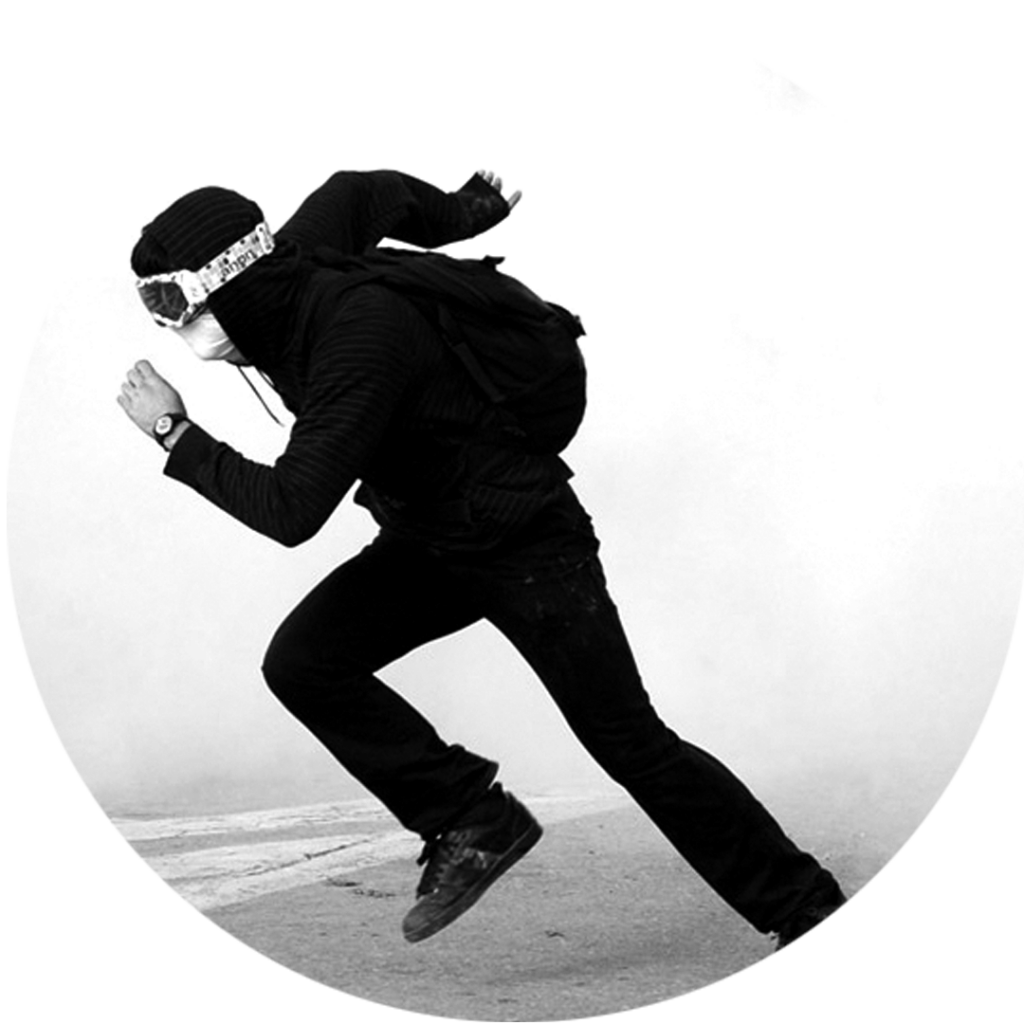
The first of these is the idea that social uprisings continue to be historically possible. The myth of “the end of history,” which all ideological apparatuses of the state waved at us like a banner for 25 years, became a rag (once again) in December 2008. And not in some peripheral or backward country, or in a dictatorship, but in a “democratic” country in the heart of Europe and at the core of the EMU (European Monetary Union). This means that in December 2008, the idea that this world can change ceased to seem like a madman’s ravings – as a utopia without any material basis, or as the vision of some marginal political subjects or groups. On the other hand, social uprisings are not predictable, they don’t obey any historical determinism, they’re not the brainchild of any political subject, however it may characterize itself. What defined that December as an uprising was primarily the mass protests of male and female students in all the high schools and middle schools of the country, who for a week would leave their classrooms during school hours to go attack police stations. December did not remain at the level of a mere clash with the various expressions of public order, however massive and widespread across the territory. It did not have the fate of the uprising in the French suburbs in 2005 or the London suburbs in 2011. The political initiative of specific anti-authoritarian tendencies led protesters to understand the state as a totality of social relations (in local government, in education, in healthcare, in information, in “culture”…) and not just as a central brain (parliament), whose nerve endings are found in the batons (or guns) of cops.
Was it just a political initiative of some anti-authoritarian tendencies that didn’t allow December to remain at the level of “riots,” or was it the emergence of the new class composition of Greek society, which to some degree the anti-authoritarian movement managed to represent and express during those days? We dare to claim the latter, and this is the second thing worth thinking about in relation to the uprising.
Besides the students, it was the precarious workers and second-generation Balkan and first-generation Asian migrants (mainly on the street), either precarious themselves or unemployed and poor, as well as male and female university students—these social segments that, with the initiative of the anti-authoritarian movement, took things further.
Never before December, in all of Greek history, had horizontal discussion and decision-making been applied in practice and on such a scale—what we call direct democracy, horizontality or autonomy—as during the uprising; simultaneously a product of the diffuse character and social characteristics of this collective subject that took center stage, but also of a historical experience of critique not only of the regime of “representative democracy”, but also of those tendencies of the movement still attached to the bankruptcy of democratic centralism, the hierarchy of command, etc. Never before – at least until June 2011 and what followed three years later: Another milestone for those still searching for the thread connecting December with the cycle of struggles that followed against the bosses’ attack, codified as the Greek debt crisis.
The third thing worth negotiating is the realization that the regime is not as solid, strong and stable as it claims to be. The most impressive fact of December was how legal order collapsed, how all meanings of legal and illegal changed. How they failed to enforce Article 48 and impose a state of emergency, which they were discussing for days, how occupying state buildings became child’s play (without any protection of asylum), without the state being able to do anything, etc. Why did all this happen, given that they have soldiers, police forces, mass media, a justice system, and a social majority that—for better or worse—either didn’t participate in the uprising or was hostile to it? Because behind those who demonstrated, clashed, occupied buildings, etc. (in any case a social minority), stood tens and hundreds of others who consented to such actions, practices and deeds, to a greater or lesser degree. There was another bloc of social relations, where the state’s benefit from crushing the former (us) decisively would be less than the cost of losing or finding the latter against it.
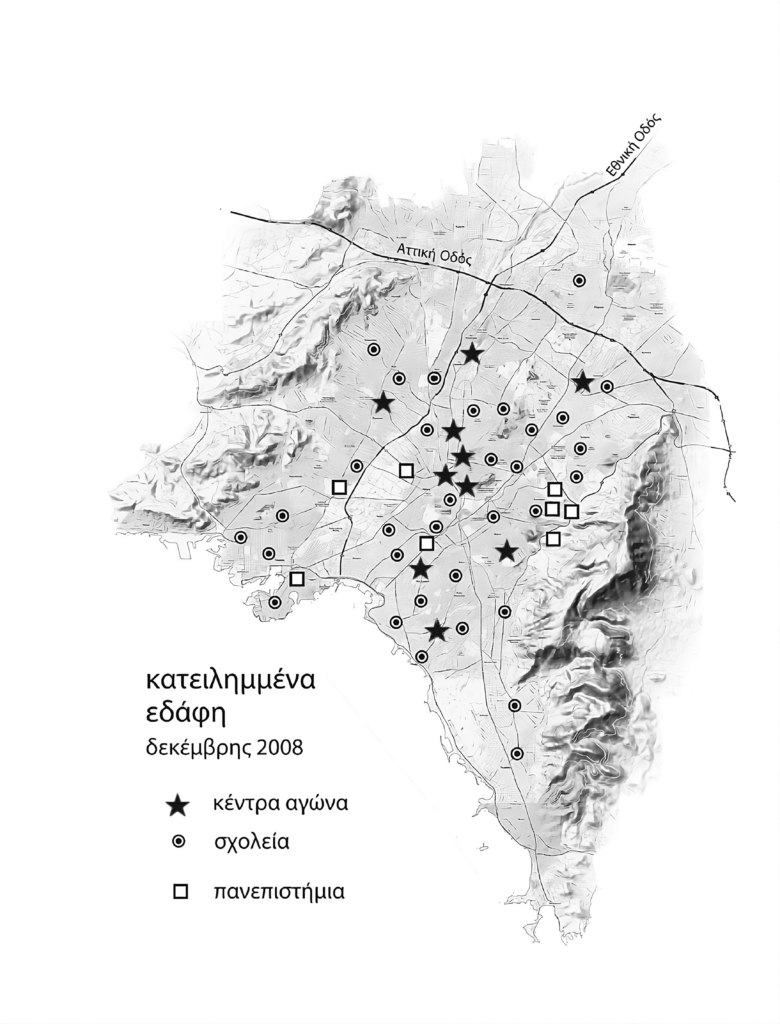
The fourth thing worth thinking about is the renegotiation of the spatial/geographical/territorial dimension of antagonistic action during the uprising. If December had been limited to three streets in central Athens, it would have been extinguished by the second day. There may have been a center of the uprising during December—Exarcheia and Patision—but in reality the initiative to expand to an extensive geographical area and to other fields of society is the reason that prolonged and deepened the uprising. All this against a metropolis-centric conception of the left and anarchy, which, steadily attached to the conceptions of the beginning of the past century, considers the triangle Propylaea-Omonia-Stadiou-Syntagma to constitute the quintessence of governmentality—a conception, however, that continues to trouble us today.
The fifth thing we must focus on is the “failure” of December. More undramatically: uprisings either enter a long path of overthrowing existing social relations, or they retreat and are defeated. Social uprisings have specific social and historical limits regarding how deep they can go, how far they can reach, which social strata they can mobilize. The first of these limits is the state of the antagonistic movement before the uprising. There are no winter palaces to occupy, there’s no heart of the state to strike, there’s no brain center to block. Where a social uprising can go depends on what came before it. What worker collectives existed in workplaces and what student assemblies existed in schools. What initiatives were developing in universities and what initiatives exist in each neighborhood. What unemployed collectives exist and what interventions flourish here and there. “Down with the state” means first and foremost I challenge the order of the director/supervisor at my job, if I’m a public sector employee, and down with capital means I challenge the order of the boss (or manager) if I work in the private sector.
Only if dual power is already material reality in the present of the uprising, even as an immature tendency, can an uprising go further. Conversely: only where it’s already present will the uprising realize the already existing dynamics for further deepening.
We must rethink revolution as a possibility “of ordinary everyday people,” as Subcomandante Marcos says, not as intellectual nonsense of (“crappy”) academics, nor as a cliché of “specialists” of rusty or smoky gun barrels. The second limit concerning how deep a social uprising will go—that is, which population strata it will embrace—concerns the causes and the seriousness of these causes, from the perspective of how deeply they affect everyday life and the very survival of the population. For better or worse, if the trigger of the uprising was the murder of a teenager and if its deeper causes were the precarity and squeeze of segments of the new class composition, these two don’t concern the totality of the society of the exploited, the totality of the class. Or they don’t concern them to the degree that would make them mobilize: from losing one or more days’ wages to risking beatings, arrests, bodily integrity, or much more: the certainty that “this life can’t go on.” Finally, the third limit concerning where the uprising can go is the material existence of a radical plan as a proposal for advancing things. And this doesn’t just mean some slogans, it means the material force that can set and move in the direction these slogans define. In few words: the masses of workers and soldiers followed the Bolsheviks in the Russian revolution, the workers and peasants followed the anarchists in the Spanish revolution because behind their proposals for the prospect of social liberation (“Peace and land” and “all power to the soviets” for the Bolsheviks and “Land and freedom” and “collectivization of the economy” for the anarchists), there were large parts of the class ready to defend these proposals. Of course, no such plan existed in December and of course the only ones who proposed something like that, some tendencies of the armed struggle, stood at the limits of cliché. Of course, no such plan exists today either, not as a plan for seizing power, but as an active discussion of the movement. This constitutes a problem for those who can perceive it.

Last but not least. December taught us in practice that the regime may not be as solid as it claims to be, but it remains more stable than some tendencies of the movement imagine it to be (and with considerable reserves). The New Democracy government and the party-state lost the initiative of movements for 20 days, but they quickly regained it on all levels. State reserves included the KKE (Greek Communist Party) which openly condemned the uprising (“in authentic popular uprisings not even one window will be broken” Papariga, the chairwoman, cheerfully declared) and abstained from every initiative, as well as (then) SYRIZA, which sometimes spoke of looting and sometimes of uprising, choosing to balance in vain both on the boat of youth militancy and on the boat of bourgeois lawfulness. State reserves were also the fascists who beat people along with the cops in Patras and Larissa, reserves were also the “respectable” intellectuals (Markaris, Theodorakopoulos, etc.) who spoke of “nihilism” and “destruction,” or the professors of revisionism (Marantzidis, Kalyvas, etc.) who wrote profound articles to prove that “December was nothing.” Each reserve was useful in the labour division of state command and for the role it has shouldered from it: ideological, artistic, material, political, etc.
There are other things worth focusing on regarding the December uprising and we don’t have the illusion that we can exhaust this list in two pages. If history has taught us anything, us who have decided to dedicate our lives to the cause of social liberation, it is the need to research and discuss in depth these moments when the class raises its head, whether they’re called revolutions, uprisings, significant strikes, or significant struggles in the diffuse social field. Not only and not mainly to defend our collective past, but to prepare our collective future. The December uprising has not yet found those who will research it in terms of oral history and antagonistic research, those who will pose it again and again as a political negotiation issue of social struggle.
If nothing else, honoring the memory of this uprising means we won’t leave this work in the hands of the specialists of the ruling class, whoever they are and wherever they come from.
And if you were a memory of December, who would you corner?
December 2025
